Translate

Thursday, 23 October 2014

How the world loved the swastika - until Hitler stole it

US Air Force aeroplane
 
In the Western world the swastika is synonymous with fascism, but it goes back thousands of years and has been used as a symbol of good fortune in almost every culture in the world. As more evidence emerges of its long pre-Nazi history in Europe, can this ancient sign ever shake off its evil associations?
In the ancient Indian language of Sanskrit, swastika means "well-being". The symbol has been used by Hindus, Buddhists and Jains for millennia and is commonly assumed to be an Indian sign.
Early Western travellers to Asia were inspired by its positive and ancient associations and started using it back home. By the beginning of the 20th Century there was a huge fad for the swastika as a benign good luck symbol.
In his book The Swastika: Symbol Beyond Redemption? US graphic design writer Steven Heller shows how it was enthusiastically adopted in the West as an architectural motif, on advertising and product design.
Label from Swastika "eating fruit" (1930s); playing cards (1920s); and a Coca-Cola pendant issued for teenagers 20th Century fad: Fruit packaging, a Coca-Cola pendant, and a pack of cards, all from the US
"Coca-Cola used it. Carlsberg used it on their beer bottles. The Boy Scouts adopted it and the Girls' Club of America called their magazine Swastika. They would even send out swastika badges to their young readers as a prize for selling copies of the magazine," he says.
It was used by American military units during World War One and it could be seen on RAF planes as late as 1939. Most of these benign uses came to a halt in the 1930s as the Nazis rose to power in Germany.
The Nazi use of the swastika stems from the work of 19th Century German scholars translating old Indian texts, who noticed similarities between their own language and Sanskrit. They concluded that Indians and Germans must have had a shared ancestry and imagined a race of white god-like warriors they called Aryans.
Indian boy with swastika on head, and vase at Sensoji Asakusa Kannon Temple, Tokyo, Japan A Hindu boy with a shaved head, and a giant vase at a Buddhist temple in Japan
This idea was seized upon by anti-Semitic nationalist groups who appropriated the swastika as an Aryan symbol to boost a sense of ancient lineage for the Germanic people.
 
The black straight-armed hakenkreuz (hooked cross) on the distinctive white circle and red background of the Nazi flag would become the most hated symbol of the 20th Century, inextricably linked to the atrocities committed under the Third Reich.
"For the Jewish people the swastika is a symbol of fear, of suppression, and of extermination. It's a symbol that we will never ever be able to change," says 93-year-old Holocaust survivor Freddie Knoller. "If they put the swastika on gravestones or synagogues, it puts a fear into us. Surely it shouldn't happen again."
The swastika was banned in Germany at the end of the war and Germany tried unsuccessfully to introduce an EU-wide ban in 2007.
The irony is that the swastika is more European in origin than most people realise. Archaeological finds have long demonstrated that the swastika is a very old symbol, but ancient examples are by no means limited to India. It was used by the Ancient Greeks, Celts, and Anglo-Saxons and some of the oldest examples have been found in Eastern Europe, from the Baltic to the Balkans .
If you want to see just how deeply rooted the swastika pattern is in Europe, a good place to start is Kiev where the National Museum of the History of Ukraine has an impressive range of exhibits.
Mammoth tusk bird figurine
Among the museum's most highly prized treasures is a small ivory figurine of a female bird. Made from the tusk of a mammoth, it was found in 1908 at the Palaeolithic settlement of Mezin near the Russian border.

Find out more

Bronze age pot
Mukti Jain Campion is the producer and presenter of Reclaiming the Swastika. You can listen on BBC Radio 4 at 11:00 on Friday 24 October - or for another 30 days on the BBC iPlayer.
On the torso of the bird is engraved an intricate meander pattern of joined up swastikas. It's the oldest identified swastika pattern in the world and has been radio carbon-dated to an astonishing 15,000 years ago. The bird was found with a number of phallic objects which supports the idea that the swastika pattern was used as a fertility symbol.
In 1965 a palaeontologist called Valentina Bibikova discovered that the swastika meander pattern on the bird is very similar to the naturally occurring pattern visible on a cross-section of ivory. Could it be that the Palaeolithic makers of the figurine were simply reflecting what they saw in nature - the huge mammoth they associated with well-being and fertility?
Single swastikas began to appear in the Neolithic Vinca culture across south-eastern Europe around 7,000 years ago. But it's in the Bronze Age that they became more widespread across the whole of Europe. In the Museum's collection there are clay pots with single swastikas encircling their upper half which date back to around 4,000 years ago. When the Nazis occupied Kiev in World War Two they were so convinced that these pots were evidence of their own Aryan ancestors that they took them back to Germany. (They were returned after the war.)
In the Museum's Grecian collection, the swastika is visible as the architectural ornament which has come to be known as the Greek key pattern, widely used on tiles and textiles to this day.
Left: Grecian architectural swastikas at the National Museum of the History of Ukraine. Right: Decoration on the Brooklyn Academy of Music Left: Grecian architectural swastikas in the Kiev museum. Right: Brooklyn Academy of Music (New York)
The Ancient Greeks also used single swastika motifs to decorate their pots and vases. One fragment in the collection from around 7th Century BCE shows a swastika with limbs like unfurling tendrils painted under the belly of a goat.
Textile fragments from the 12th Century Fragments of a 12th Century princess's collar
Perhaps the most surprising exhibit in the museum is of fragile textile fragments that have survived from the 12th Century AD. They are believed to belong to the dress collar of a Slav princess, embroidered with gold crosses and swastikas to ward off evil.
The swastika remained a popular embroidery motif in Eastern Europe and Russia right up to World War Two. A Russian author called Pavel Kutenkov has identified nearly 200 variations across the region. But the hakenkreuz remains a highly charged symbol. In 1941 Kiev was the site of one of the worst Nazi mass murders of the Holocaust when nearly 34,000 Jews were rounded up and killed at the ravine of Babi Yar.
In Western Europe the use of indigenous ancient swastikas petered out long before the modern era but examples can be found in many places such as the famous Bronze Age Swastika Stone on Ilkley Moor in Yorkshire.
Some people think this long history can help revive the symbol in Europe as something positive. Peter Madsen, owner of an upmarket tattoo parlour in Copenhagen says the swastika is an element of Norse mythology that holds a strong appeal to many Scandinavians. He is one of the founders of last year's Learn to Love the Swastika Day on 13 November, when tattoo artists around the world offered free swastikas, to raise awareness of the symbol's long multicultural past.
"The swastika is a symbol of love and Hitler abused it. We're not trying to reclaim the hakenkreuz. That would be impossible. Nor is it something we want people to forget," he says.
Man (Phil Cummins) showing swastika tattoo One of the supporters of the Learn to Love the Swastika movement
"We just want people to know that the swastika comes in many other forms, none of which have ever been used for anything bad. We are also trying to show the right-wing fascists that it's wrong to use this symbol. If we can educate the public about the true meanings of the swastika, maybe we can take it away from the fascists."
But for those like Freddie Knoller who have experienced the horrors of fascism, the prospect of learning to love the swastika is not so easy.
"For the people who went through the Holocaust, we will always remember what the swastika was like in our life - a symbol of pure evil," he says.
"We didn't know how the symbol dates back so many thousands of years ago. But I think it's interesting for people to learn that the swastika was not always the symbol of fascism."

Miranda Hart calls time on BBC sitcom

TV star Miranda Hart has announced there will be no more episodes of her hit BBC sitcom after this Christmas.
"I'm actually coming to the end of the whole sitcom," she revealed on Steve Wright's BBC Radio 2 show on Thursday.
"I'm doing two Christmas specials, but they are going to be the finale of the show, full stop," she continued.
The 41-year-old actress and comedienne said it was "the right time to end it" and wanted the programme to go out "on a high".
She said the filming of the last two episodes in November would be "really emotional" and she would miss making the programme.
Miranda, which first aired on BBC Two before moving to BBC One, cast its creator as a joke shop owner prone to committing social faux pas.
The programme also featured Patricia Hodge as her TV alter-ego's mother and Sarah Hadland as her shop's assistant manager.
 
The sitcom drew huge audiences with its slapstick humour and plots revolving around her character's disastrous love life.
Yet Hart told Wright she wanted the character to "come into her own" and "be happy in herself".
"People have loved the character, which is so nice and amazing for me," she told the afternoon DJ.
"But as she gets older I don't want her to keep falling over and make a complete fool of herself."
Hart also addressed speculation she is to launch a revival of classic BBC game show The Generation Game.
"I am thinking about an entertainment format [and] there might be elements of The Generation Game," said the Call the Midwife star.
"We're thinking how The Generation Game could possibly work in 2015."
First broadcast in 1971, the slapstick show was hosted by Sir Bruce Forsyth, Larry Grayson and others over the course of its three-decade life-span.

Wednesday, 22 October 2014

The Story of Medusa and Athena

Once upon a time, a long time ago there lived a beautiful maiden named Medusa.  Medusa lived in the city of Athens in a country named Greece -- and although there were many pretty girls in the city, Medusa was considered the most lovely.
 
Unfortunately, Medusa was very proud of her beauty and thought or spoke of little else.  Each day she boasted of how pretty she was and each day her boasts became more outrageous.
 
On Sunday, Medusa bragged to the miller that her skin was more beautiful than fresh fallen snow.  On Monday, she told the cobbler that her hair glowed brighter than the sun.  On Tuesday, she commented to the blacksmith’s son that her eyes were greener than the Aegean Sea.  On Wednesday, she boasted to everyone at the public gardens that her lips were redder than the reddest rose.
 
When she wasn’t busy sharing her thoughts about her beauty with all who passed by, Medusa would gaze lovingly at her reflection in the mirror.  She admired herself in her hand mirror for an hour each morning as she brushed her hair.  She admired herself in her darkened window for an hour each evening as she got ready for bed.  She even stopped to admire herself in the well each afternoon as she drew water for her father's horses -- often forgetting to fetch the water in her distraction.
 
On and on Medusa went about her beauty to anyone and everyone who stopped long enough to hear her -- until one day when she made her first visit to the Parthenon with her friends.  The Parthenon was the largest temple to the goddess Athena in all the land.  It was decorated with amazing sculptures and paintings.  Everyone who entered was awed by the beauty of the place and couldn’t help but think of how grateful they were to Athena, goddess of wisdom, for inspiring them and for watching over their city of Athens.  Everyone, that is, except Medusa.
 
When Medusa saw the sculptures, she whispered that she would have made a much better subject for the sculptor than Athena had.  When Medusa saw the artwork, she commented that the artist had done a fine job considering the goddess's thick eyebrows -- but imagine how much more wonderful the painting would be if it was of someone as delicate as Medusa.
 
And when Medusa reached the altar she sighed happily and said, “My this is a beautiful temple.  It is a shame it was wasted on Athena for I am so much prettier than she is – perhaps some day people will build an even grander temple to my beauty.”
 
Medusa’s friends grew pale.  The priestesses who overheard Medusa gasped.  Whispers ran through all the people in the temple who quickly began to leave -- for everyone knew that Athena enjoyed watching over the people of Athens and feared what might happen if the goddess had overheard Medusa’s rash remarks.
 
Before long the temple was empty of everyone except Medusa, who was so busy gazing proudly at her reflection in the large bronze doors that she hadn't noticed the swift departure of everyone else.  The image she was gazing at wavered and suddenly, instead of her own features, it was the face of Athena that Medusa saw reflected back at her.
 
“Vain and foolish girl,” Athena said angrily, “You think you are prettier than I am! I doubt it to be true, but even if it were -- there is more to life than beauty alone.  While others work and play and learn, you do little but boast and admire yourself.”
 
Medusa tried to point out that her beauty was an inspiration to those around her and that she made their lives better by simply looking so lovely, but Athena silenced her with a frustrated wave.
 
“Nonsense,” Athena retorted, “Beauty fades swiftly in all mortals.  It does not comfort the sick, teach the unskilled or feed the hungry.  And by my powers, your loveliness shall be stripped away completely.  Your fate shall serve as a reminder to others to control their pride.”
 
And with those words Medusa’s face changed to that of a hideous monster.  Her hair twisted and thickened into horrible snakes that hissed and fought each other atop her head.
 
“Medusa, for your pride this has been done.  Your face is now so terrible to behold that the mere sight of it will turn a man to stone,” proclaimed the goddess, “Even you, Medusa, should you seek your reflection, shall turn to rock the instant you see your face.”
 
And with that, Athena sent Medusa with her hair of snakes to live with the blind monsters -- the gorgon sisters -- at the ends of the earth, so that no innocents would be accidentally turned to stone at the sight of her.

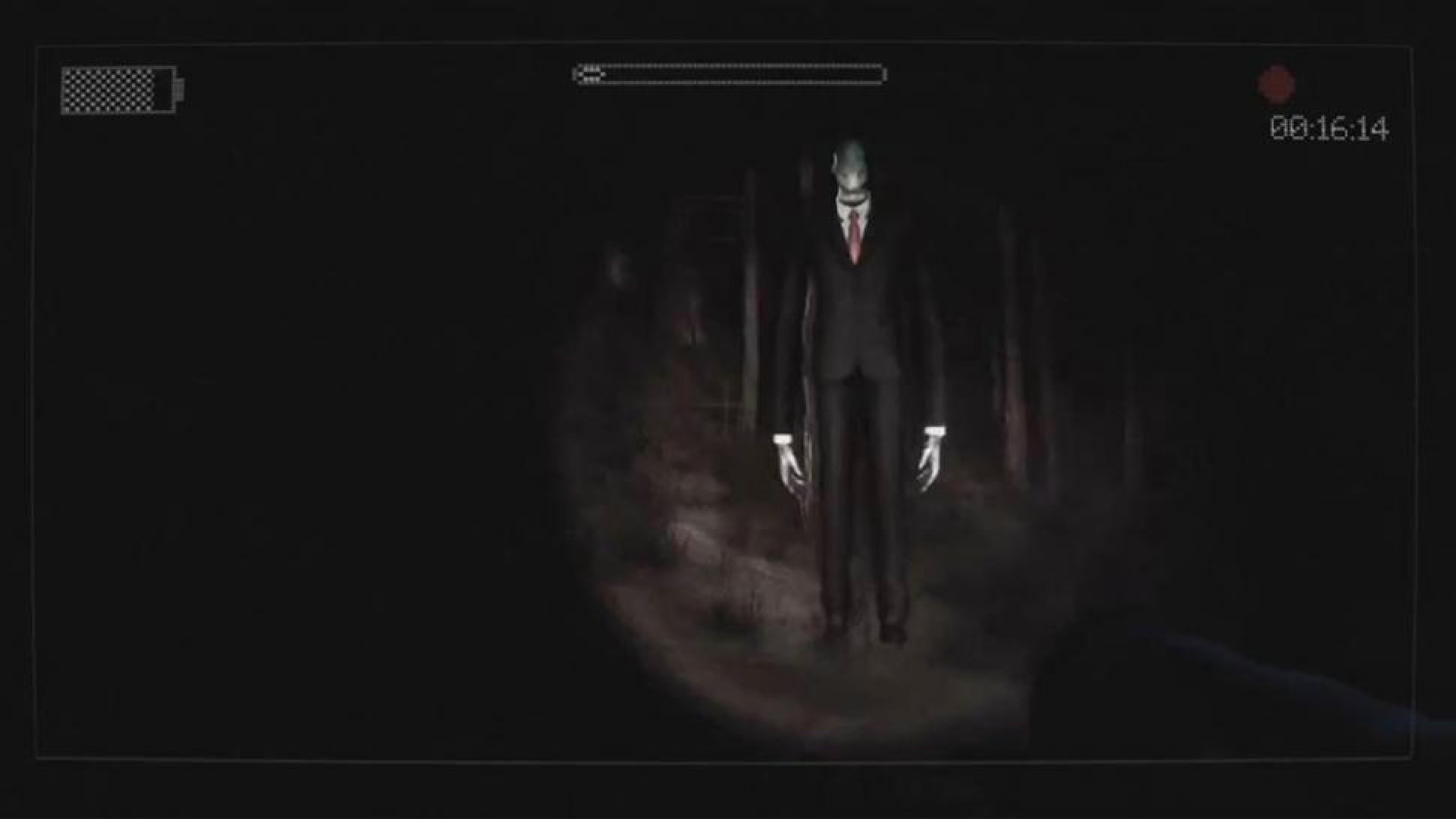
Slender Man

The Slender Man  is a creature or being with various nebulously defined characteristics and abilities. Slender Man was first mentioned in Something Awful Forum's "Create Paranormal Images". Slender Man generally appears (in modern times) as a tall man in a black or grey suit, red or black tie, and white shirt, with no eyes, mouth, or clearly defined facial features. It has no hair, and generally has normal-looking bare hands. Slenderman typically is depicted in imagery and literature as between 6 and 15 feet tall, depending on the situation, and in video as around 6-7 feet tall. Because of its inexact nature, and differences between series, no one has yet determined what it is. Currently, the two leading theories as to what the Slenderman may be are the Tulpa Effect and Quantum Theory. The internet popularity of Slenderman has spawned a massive amount of interconnected ARGs, collectively known as the Slenderman Mythos.
 
In almost every description Slenderman's basic attributes will vary greatly, however several basic traits are typical of his behavior. He is shown to behave in a very passive aggressive manner, stalking targets for years at a time, torturing his target mentally for various unknown reasons. He is rarely ever shown in a benevolent light and is typically shown as a malevolent force. This behavioral pattern has an uncertain reasoning behind it, and exactly why he behaves in such a way has yet to be fully ascertained.

The most important factor about Slenderman is the mystery. He lives unlike any human being despite having a similar appearance to one. It is uncertain if he is social, or even understands human languages or behaviors, nor why it is humans appear to be his main target. His targets will typically behave in off ways as if possessed, but whether their psychosis is causing them to speak for him or for themselves isn't entirely certain either.
 
Slenderman's appearance is variable as the years go on, but as of to date the most recent appearance is that of an abnormally tall human with long arms and no face whom is wearing a business suit. Again it is uncertain if his suit is real cloth or some form of skin molded into such an appearance. If it is the former, this would imply an intelligent being attempting to try to blend in. If it is the latter, it shows a being whom is extremely adaptive and evolves to match his environment and stick out less (or more).
Slender-The-Arrival-Teaser-Trailer 9
Slenderman's appearance provokes a wide range of responses, the most common being fear. This is partially due to his extremely towering size over a full grown adult, which mimics the childhood fear of adult humans bigger than the child. His behavior also factors into it. Finally, the main fact is he is completely unable to be described in human terms. While a description in words can be given, human language lacks the ability to truly define the entity until such a time as when humans can interact with him. This problem stems from the fact that he operates in a plane of existence further from humans. This is believed to be fourth dimensional space which gives him powers a human cannot understand due to humans living in three dimensions of space and being unable to comprehend the fourth dimension at this time.
 
In total two major types of Slender Man descriptions exist. The original versions depict him as not only malevolent, but extremely dangerous. He will do odd things such as removing organs and placing them in bags, impaling targets on trees, and aggressively stalking targets after a period of time. A contemporary depiction shows Slender Man as being extremely passive aggressive, often letting a person slowly delve into madness at their situation until being unable to cope. If invited to anger, he will typically charge a target down until caught and vanish with them to unknown locations. This version also shows an odd response to electronic equipment and causes massive problems with audio, surveillance, camera, and other various electronic devices with displays or audio. Sometimes an individual can determine if he is near simply by how certain electronics react such as radios, televisions, or cameras. How powerful this effect is seems to vary, and can either be due to Slender Man's own state of aggression, or other outside factors either inside or beyond Slender Man's control.
 
Slender Man has no exactly defined or specified history, however contributors have placed early sightings of Slenderman-like beings in early 1600s Germany and before, where it took the dress of a knight or royal figure. Germanic fairy tales and mythology also makes use of the creatures to be used as cautionary tales for children.
 
Photographs from the early 1900s were the next confirmed reports, where imagery of Slender Man can be found in classical black and white and sepia imagery. Reports from this time indicate sightings in America, the UK, and Russia, as well as reports of child disappearances.
By the mid-1900s, some rare run-ins occurred in the war zones in Germany, apparently Slender Man's native land. Soldiers were the primary targets here. In America and Canada, reports of missing skiers and children appeared, coming from forested areas of the nations.
After a spree of building burnings from unknown causes, several deaths and a few surviving witnesses, it could be gathered that the Slender Man had the following traits:
  • Slender Man will find interest in a victim for reasons unknown
  • It would then contact the victim, if it is a child, presenting itself as friendly
  • The adults he stalks have a common trait: they have all been through a terrible tragedy in their life, even if the tragedy was made by Slender Man directly
  • If an adult, it would stalk the victim for long amounts of time causing what is known as "Slender sickness" causing massive paranoia, nose bleeds, nightmares, hallucinations appearing to only the sick person, and many other dangerous symptoms.
  • Eventually, it would abduct the victim into nearby forest, where they would be killed.
  • In 'messy' cases, it may remove evidence of its existence by causing fire of their home, place of work, or school
Death of the victim originally occurred through an odd means- the victim would be impaled on branches of very tall trees while still alive, and bleed to death. The organs would be individually removed, then placed in plastic bags. They would then be replaced into the body in their original positions, plus the plastic bags. The victims' corpses do not show any sign of a struggle. As time has gone on, this practice has seemingly been abandoned.
In the late 1990s, technology shed more light on the creature through the use of commonplace cameras and camcorders. Slender Man was recorded and photographed stalking potential victims many times.
 
In the late 2000s to early 2010s, several individuals recorded ongoing stalking and attack scenarios of themselves and their friends. These video accounts are codenamed Marble Hornets, EverymanHYBRID, DarkHarvest00, MLAndersen0, and TribeTwelve. As well as certain Rivn videos.
 
The new foray into Slender Man's powers, abilities, and attacks have shown drastic difference from his original behaviours. The original desire to impale targets on trees, his rather aggressive attitude, and attacking mainly children have been altered. It appears he seems to enjoy targeting humans who have seen him in childhood and following them for years. He appears to do so in such a way that the target is unaware of his presence for potentially months, years, or even decades, and typically won't be aware at any point in time until it is far too late.
 
His behaviour is extremely passive aggressive, where he stalks, follows, and torments an individual by repeatedly showing his presence. He will typically do so in invasive ways, such as appearing inside someone's house, outside their home, on roads they travel, at their place of work when they are alone, or while the target is sleeping. This will create a general unease of the target, as the invasion of an entity in their own safety zone will begin sparking incredible paranoia. Most often he won't attack the target for extended periods, instead just following the target and tormenting them. This period can last anywhere from several minutes to years.
 
The behaviour of taking organs out or impaling targets have been long forgotten. If his new modus operandi is to be believed, the target is taken away with no traces whatsoever. The target will never be found, nor are any traces. Thus his new method of killing targets is unknown, as no victim is ever found. The victim will typically
disappear by him/herself, thus these attacks are unrecorded and unknown. What little camera footage has been found shows incredible distortion on them in typical cases, making it nearly impossible to understand exactly what he has done. To date it is unknown where his victims go, or what he does with them after this.
 
One of the most powerful new traits Slender Man will typically employ seems to be some form of inhibiting memory loss. Like Slender Sickness, this effect can be nearly immediate just on close contact with him, although it seems to vary as to exactly how powerful. In some cases individuals will forget the past few minutes, however extended contact has led people to awakening in locations they are uncertain of due to running from Slender Man and their brain beginning to write memory and restore consciousness after a given period of time. In some cases, it is believed Slender Man himself will deposit a victim in an unknown location and leave them to awaken after an attack. This effect is akin to Slender Sickness, but is the most powerful effect of the sickness to date.
 
Victims of extended periods will note excessive damage to their social, physical, and career life. Typically individuals will show massive moods swings and constant irritation, not to mention will lose track of large periods of time, making communication with friends or holding down steady work difficult, as memory losses could be as long as several weeks or months until the individual awakens and attempts to return to their life only to find it ruined. Despite this, Slender Man will continue his behaviour.

Brian Griffin

Brian Griffin is a fictional character from the animated television series Family Guy. An anthropomorphic dog, voiced by Seth MacFarlane, he is one of the show's main characters and a member of the Griffin family. He primarily works in the series as a struggling writer, attempting essays, novels, screenplays and newspaper articles.
 
Brian Griffin.pngHe first appeared on television, along with the rest of the family, in a 15-minute short on December 20, 1998. Brian was created and designed by MacFarlane himself. MacFarlane was asked to pitch a pilot to the Fox Broadcasting Company, based on The Life of Larry and Larry & Steve, two shorts made by MacFarlane which featured a middle-aged character named Larry and an intellectual dog, Steve. After the pilot was given the green light, the Griffin family appeared on the episode "Death Has a Shadow". Brian's appearance is a redesign of Steve the dog, from MacFarlane's previous show.
 
Brian has been featured in many items of merchandise for Family Guy and he is considered to be one of the show's biggest merchandising icons. He has also made crossover appearances in the other MacFarlane-produced shows; American Dad! and The Cleveland Show. As a character, Brian has been very well received by critics and fans. When Brian was killed in the Season 12 episode, "Life of Brian", the events of the episode received substantial attention from the media, and elicited strongly negative reactions from fans of the show. Brian subsequently returned two episodes later, in "Christmas Guy", after Stewie travels back in time to save him.

What Women Think!

I am not talking about everyone, nor am I an expert on all matters of the heart; but what I can say is that not all women are the same. Yesterday I wrote a story about what women think when they go down on their men. I simply looking it up and summarised what I think women think about; not saying all the women I was writing about feel the same way. Supposedly when we have sex, we lose the ability to  think as we reach organism. Which means women don't really think when they go down they just do what they like and what their partner wants.  
 
Throughout all my experiences I can honestly say I personally don't have the time to think about what is going through my head, if I have any regrets I will worry about them later. For example when you kiss the one person you love in the whole world you lose track of the time that has went past and I also lose logically thinking in the short space of time. I guess that's how you find out if you are with the person you are meant to be with. Which I am happy with the results.
 
But when you  have relations with people that you don't love and then you start and confuse yourself. Whether that was a good idea. What made you do that. Etc.
 
Thought I would use a diagram of an actual heart instead of what we use as the pictogram of the cartoon heart, which goes with my next point. "follow your heart, but don't ignore your head"

UFO sighting stories


Roswell, 1947The Roswell Incident Alien autopsy? A still from the documentary The Roswell Incident Photograph: Channel 4
Conspiracy theorists claimed the US military had captured a crashed alien aircraft, but "The Man" maintained it had merely recovered debris from a top secret surveillance balloon. Ask Ant & Dec – they made a film about it: 2006 flop Alien Autopsy.

 Belgian wave, 1989-90

The Belgian UFO wave from 29 November 1989 to April 1990. A sighting from the Belgian UFO wave (29 November 1989 to April 1990).
Over five months, 13,500 people claimed to have witnessed large, silent, low-flying black triangles, and around 2,600 of them filed written statements. Sceptics blame helicopters or mass delusions caused by eating chips with mayonnaise.